Core vs Enhanced SMCR categorisation: what the FCA expects from your firm

The Senior Managers and Certification Regime (SMCR) applies to all solo-regulated financial services firms in the United Kingdom, categorising them into Core, Enhanced, or Limited Scope regimes based on criteria in the Financial Conduct Authority (FCA) Handbook. At Compliance Consultant, we see that most mid-sized investment managers, advisory firms, and commercial brokers default directly into the Core tier, requiring a mandatory baseline of Senior Management Functions (SMFs), Prescribed Responsibilities, and fit and proper verifications. Enhanced firms face significantly heavier regulatory burdens, including formal Responsibilities Maps and additional governance checks, while Limited Scope entities operate under restricted obligations. Accurately determining your classification under Chapter 23 of the Senior Management Arrangements, Systems and Controls sourcebook (SYSC 23) determines the personal regulatory accountability of your leadership team.
Under the Financial Services and Markets Act 2000 (FSMA), approved senior managers carry a statutory Duty of Responsibility. If a regulatory breach occurs in a manager's area of oversight, that individual must demonstrate to the regulator that they took reasonable steps to prevent or stop the failure. Determining whether your firm sits in Core, Enhanced, or Limited Scope dictates how you must allocate and document those operational boundaries.
Quick verdict: understanding the three tiers of SMCR
Solo-regulated firms must classify themselves under the rules set out in SYSC 23 Annex 1R. The FCA does not assign these categories on your behalf; the obligation to determine your classification rests squarely with your governing board.
The three distinct categories reflect firm size, operational complexity, and potential impact on consumers:
- Core firms represent the standard regulatory baseline, encompassing the majority of solo-regulated investment managers, corporate finance boutiques, and intermediaries.
- Enhanced firms meet specific quantitative financial thresholds or qualitative supervisory criteria, subjecting them to comprehensive structural and governance controls.
- Limited Scope firms possess restricted permissions, such as limited-permission consumer credit businesses or sole-purpose claims management companies, and carry reduced senior management overheads.
Failing to identify that growth has pushed a business into the Enhanced tier leaves the firm non-compliant with governance mapping, handover procedures, and additional Prescribed Responsibilities. Conversely, over-engineering compliance by adopting Enhanced controls within a small Core firm wastes operational resources.

Overview of each SMCR category
The classification criteria detailed in SYSC 23 of the FCA Handbook evaluate firm operations across several balance-sheet, asset, and revenue metrics. Assessing these thresholds requires review against the firm's regular regulatory reporting via RegData.
Core SMCR firms
The Core tier serves as the default category. If an authorised firm does not qualify as Limited Scope and does not breach the statutory quantitative thresholds for the Enhanced regime, it is a Core firm.
A typical Core firm must appoint individuals to mandatory Senior Management Functions where those roles exist, such as the Chief Executive (SMF1), Executive Director (SMF3), Compliance Oversight (SMF16), and the Money Laundering Reporting Officer (SMF17). Every individual performing an SMF role must secure pre-approval from the regulator before taking up their responsibilities. In addition, Core firms must allocate a set of standard Prescribed Responsibilities across their approved senior managers, verifying that no governance gaps exist.
Core firms do not need to submit formal Responsibilities Maps or establish documented handover arrangements under statutory rules. However, they must maintain unambiguous, up-to-date Statements of Responsibilities (SoRs) for every approved manager.
Enhanced scope SMCR firms
The Enhanced category captures a small percentage of solo-regulated businesses whose scale or systemic profile presents higher potential risk to consumers or financial markets. A firm crosses into Enhanced status if it meets any of several financial and operational criteria:
- Assets under management (AUM) of £65 billion or more, measured as a three-year rolling average on RegData return FSA038.
- Total annual intermediary regulated business revenue of £45 million or more on a three-year rolling average.
- Regulated consumer credit lending annual turnover of £130 million or more, calculated as a three-year rolling average.
- Non-bank mortgage lending or administration with 10,000 or more regulated mortgages outstanding.
- Designation as a Significant SYSC firm under the rules in SYSC 23 Annex 1.
- Classification as a CASS Large debt or asset holding firm under Client Assets sourcebook rules.
Enhanced firms must comply with extensive structural mandates. These include appointing individuals to broader Senior Management Functions such as Chief Finance Officer (SMF2), Chief Risk Officer (SMF4), Chief Operations Officer (SMF24), and Head of Internal Audit (SMF5). Enhanced entities must also maintain an overarching single Responsibilities Map and run formal handover procedures whenever senior responsibilities transfer between individuals.
Limited scope SMCR firms
The Limited Scope tier is reserved for businesses with narrow or specialised authorisations. Common examples include limited-permission consumer credit providers (such as retailers offering point-of-sale financing), authorised professional firms conducting non-mainstream regulated activities, internally managed Alternative Investment Funds (AIFs), and standalone funeral plan distribution firms.
These organisations are exempt from Prescribed Responsibilities. Their regulatory overhead is minimal: they typically register only one or two SMFs (such as an Apportionment and Oversight function or Limited Scope Director) and are excluded from the broader governance infrastructure expected of mainstream investment and intermediation businesses.
Head-to-head comparison: obligations by firm type
The table below contrasts the regulatory demands across the three solo-regulated tiers under the FCA Senior Managers Regime rules:
| Requirement | Core | Enhanced | Limited Scope |
|---|---|---|---|
| Statements of Responsibilities (SoRs) | Mandatory for every SMF | Mandatory for every SMF | Mandatory for approved SMFs |
| Management Responsibilities Map | Not required | Mandatory under SYSC 25 | Not required |
| Prescribed Responsibilities | Standard Core allocation | Full Enhanced allocation | Exempt |
| Standard Senior Management Functions | Baseline set (e.g. SMF1, 3, 16, 17) | Full suite (including SMF2, 4, 5, 24) | Minimal (e.g. SMF29) |
| Handover Procedures | Good practice only | Mandatory under SYSC 25.9 | Not required |
| Criminal Record Checks for SMFs | Mandatory before approval | Mandatory before approval | Mandatory before approval |
| Annual Fitness and Propriety Reviews | Mandatory for SMF and Certified staff | Mandatory for SMF and Certified staff | Mandatory for SMFs |
| Duty of Responsibility (FSMA s.66B) | Applies to all approved SMFs | Applies to all approved SMFs | Applies to all approved SMFs |
This operational split demonstrates why clear classification matters. While a Core wealth manager does not need the extensive board-level documentation required of an Enhanced multi-asset platform, both entities face identical scrutiny regarding the personal accountability of their senior management.
The three components of the regime
The SMCR framework consists of three distinct pillars that apply across the workforce, from executive leadership to technical personnel.
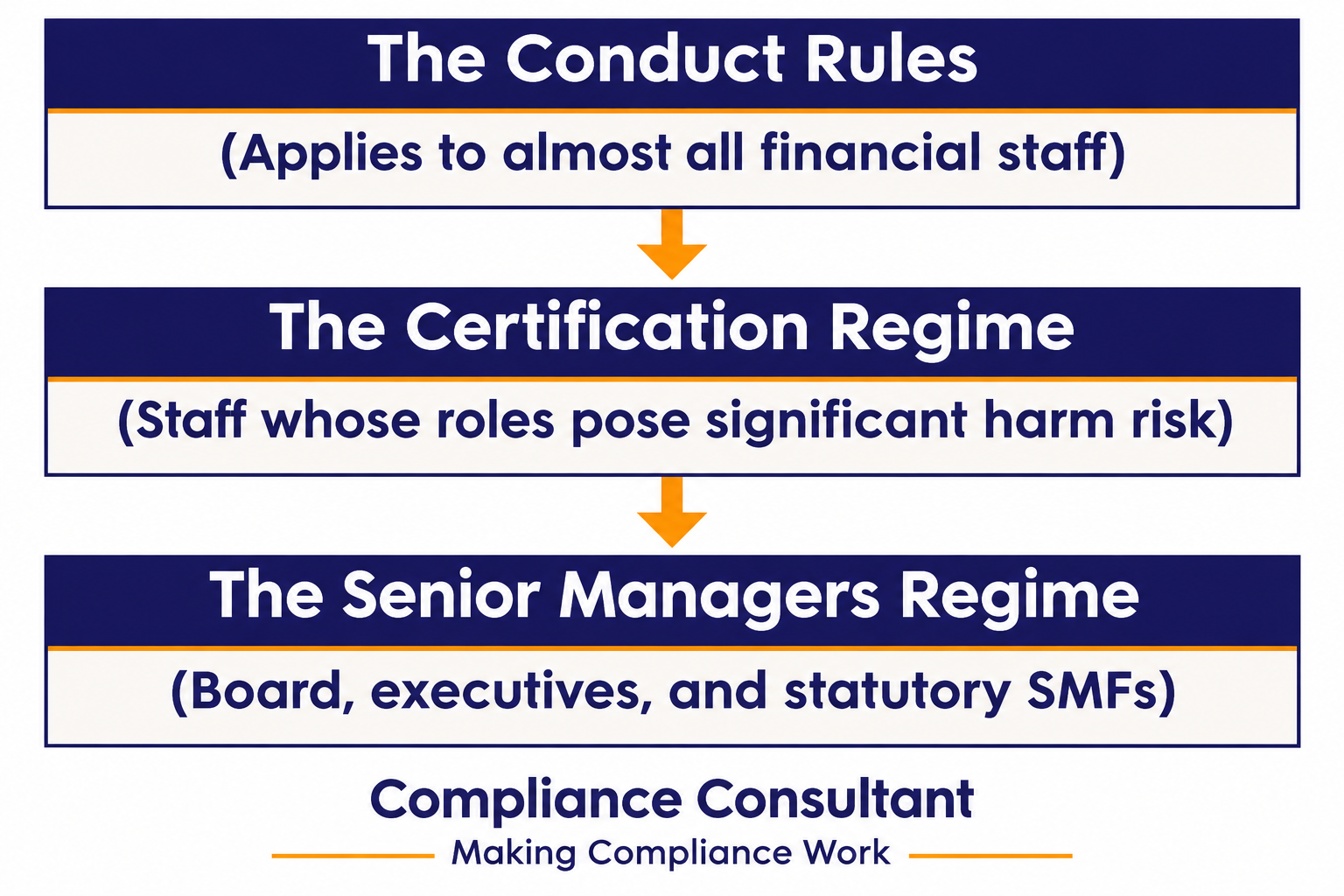
The Senior Managers Regime
The first pillar focuses on individuals who hold the greatest decision-making authority. Every SMF candidate must satisfy rigorous initial vetting. The firm must verify their competence, honesty, and financial soundness before submitting a Form A application through the FCA Connect portal.
Under SYSC 23.3 of the FCA Handbook, firms must carry out criminal records checks as part of this vetting process. Under recent procedural updates, criminal record certificates carry a six-month validity window for application submissions.
Every Senior Manager receives an SoR detailing their operational boundaries. When things go wrong, the FCA evaluates this document alongside actual firm practice to determine whether the individual discharged their Duty of Responsibility. It is not enough to hold a title; senior managers must demonstrate reasonable oversight, effective delegation, and active supervision.
The Certification Regime
The Certification Regime covers employees who are not Senior Managers but whose job functions can cause significant harm to the firm, its clients, or market integrity. Unlike SMFs, certified individuals do not require direct FCA approval.
Instead, the responsibility for vetting and certifying these professionals shifts entirely to the firm. Typical certification functions include material risk takers, staff who supervise certified personnel, individuals dealing with client assets, algorithmic traders, and advisers offering investment or mortgage solutions.
Firms must assess and certify these employees at least once every 12 months. This fitness and propriety evaluation requires testing technical competence, checking regulatory references from previous employers covering a six-year period, and assessing honesty, integrity, and financial soundness.
The Conduct Rules
The Conduct Rules represent basic standards of professional behaviour that apply to almost all individuals working in a regulated firm, excluding ancillary staff such as facilities, catering, or postroom personnel.
These standards are split into two tiers:
- Individual Conduct Rules (Tier 1): Rule 1 requires acting with integrity; Rule 2 requires acting with due skill, care, and diligence; Rule 3 demands being open and cooperative with regulators; Rule 4 mandates paying due regard to the interests of customers and treating them fairly; Rule 5 requires observing proper standards of market conduct. Under Consumer Duty provisions, Rule 6 requires staff to act to deliver good outcomes for retail customers.
- Senior Manager Conduct Rules (Tier 2): SC1 mandates taking reasonable steps to verify that the business of the firm is controlled effectively; SC2 requires taking reasonable steps to comply with relevant regulatory requirements; SC3 requires reasonable steps in delegating responsibilities; SC4 demands disclosing appropriately any information the FCA or PRA would reasonably expect.
Firms have a statutory duty to train relevant staff on how the Conduct Rules apply to their day-to-day duties. If a formal disciplinary sanction is issued against an employee for a Conduct Rule breach, the firm must notify the FCA via a standard regulatory return.

Evidencing compliance and mapping responsibilities
Allocating responsibilities on paper is straightforward; proving ongoing governance to regulatory auditors is where firms encounter friction. Under section 63(2A) of the Financial Services and Markets Act 2000, regulated businesses must carry out an annual fitness and propriety review for all approved SMF managers.
Conducting these reviews requires structured evidence gathering. A credible assessment checks whether the individual maintained continuous professional development, reviews their performance against agreed business objectives, checks personal credit records and directorship registers, and verifies that the manager has complied with the Conduct Rules.
For growing businesses, managing regulatory governance often benefits from an independent perspective. When your board requires an independent, evidence-based review of your governance and SMCR arrangements, third-party audits test whether Statements of Responsibilities reflect reality or whether blind spots exist between operational heads. A thorough review provides a RAG-rated action plan your board can act on directly.
To streamline internal tracking, compliance leads can download our SMCR Responsibilities Mapping Playbook, which provides a complete framework for allocating, documenting, and evidencing Senior Manager responsibilities under the regime.
When assessing governance costs, many mid-market firms compare retained advisory support against full-time hires. As analysed in our benchmarking of what mid-sized UK investment firms spend on FCA compliance, a full-time compliance manager commands an assumed base salary of £60,000, with employer National Insurance (15% above the £5,000 threshold) adding £8,250, employer pension contributions (assumed 5%) adding £3,000, and year-one recruitment fees (assumed 20%) adding £12,000, resulting in a first-year total of £83,250 (£71,250 in year two). In contrast, structured compliance retainer services provide senior expertise, regulatory updates, and template toolkits at fixed price points without expanding permanent headcount.
Retained compliance support is not the right choice for every business. When a firm's operational complexity, trading volume, or multi-jurisdictional licensing requires daily, full-time physical management on the trading floor, employing an internal Head of Compliance is appropriate. For firms needing senior expertise and continuity across their annual SMCR reviews, retainers bridge the operational gap effectively.
To review how your SMCR frameworks, Prescribed Responsibilities, and annual certification processes measure up to FCA expectations, explore our retained advisory support or contact our advisory team directly.
UK Freephone: 0800 689 0190
International: 020 8243 8620
Email: info@complianceconsultant.org
Book a discovery call: Schedule via our booking link
Main website: https://complianceconsultant.org/
Compliance Consultant and Compliance Doctor are trading styles of UK Compliance Consultant Limited, Companies House number 14805896. UK Compliance Consultant Limited is not authorised by the FCA.