The FCA compliance retainer: actual costs and what gets delivered

Compliance retainer services for FCA-regulated firms: what you can outsource and what stays with your board
A compliance retainer gives an FCA-regulated firm a fixed monthly allocation of senior advisory hours, scheduled monitoring and regulatory horizon scanning from an external consultancy. It lets you outsource compliance activity. It does not let you outsource regulatory accountability: under SYSC 8, a firm that outsources an important function remains fully responsible for discharging its obligations under the regulatory system. Compliance Consultant's retainers start at £535 a month plus VAT (Bronze, annual billing) or £595 a month plus VAT (Bronze, quarterly billing), and run to £2,395 a month plus VAT for the Gold tier. This guide explains what a retainer should cover, which tier fits which firm, what it costs against an in-house hire, and how your board should test the arrangement each year.
At a glance
- The rule: outsourcing does not transfer responsibility. SYSC 8.1.6R states that a firm which outsources critical or important operational functions remains fully responsible for discharging all of its obligations under the regulatory system. Principle 3 requires the firm to organise and control its affairs responsibly and effectively.
- What supervisors look for: a signed scope, evidence that senior managers review and challenge the external advice, and a log showing that remedial actions were carried out.
- The tiers: Bronze (4 hours a month), Silver (8 hours) and Gold (16 hours), each with a defined response time and toolkit.
- The cost comparison: in our worked example, an in-house compliance manager costs £83,250 in year one. Gold on annual billing is 31% of that; Bronze is 7.7%.
- The annual test: five board-level questions on scope, delivery, MI quality, independent challenge and knowledge transfer.
Outsourcing compliance work does not outsource accountability
In the firms we have reviewed, regulatory problems rarely start with one bad decision. They start when an operational change is noticed late, a monitoring review slips by a quarter, or a Senior Managers and Certification Regime (SMCR) record falls out of date because its owner left six months ago. Some boards treat an external compliance mandate as an insurance policy that moves regulatory risk outside the business. That assumption does not survive supervisory scrutiny.
The FCA supervises your governing body and your senior managers, not your adviser. The regulator's own guidance on assessing and monitoring consultants makes the same point from the other direction: firms are expected to check that a consultant can deliver what they need, agree what they will get, and monitor the service once it starts.
A defensible retainer therefore separates the execution of compliance tasks from the ownership of regulatory responsibility. For core and enhanced SMCR firms, oversight of the relationship normally sits with the Chief Executive (SMF1) or the Compliance Oversight function (SMF16). Limited scope firms, which have no SMF16, still need a named senior manager who reviews and challenges the adviser's output. Payment and e-money institutions sit outside SMCR and outside SYSC 8, but their own outsourcing conditions, under the Payment Services Regulations 2017 and Electronic Money Regulations 2011, rest on the same principle: the institution stays responsible.
Supervisors examine three things when they look at an outsourced compliance arrangement:
- A signed agreement setting out exactly which compliance tasks the provider performs and which remain in-house.
- Records of senior management review, showing that designated senior managers regularly consider the external advice and test the findings.
- An auditable remediation log, showing that actions identified in compliance reviews were carried out by the firm.
If your board cannot produce written evidence of regular oversight and active challenge, the FCA is likely to see the relationship as an abdication of governance. A retainer adds capability and capacity. The regulatory exposure stays with your firm.
What a retainer covers in practice
The most common failure in retained compliance support is an undefined scope. The firm assumes the monthly fee means the consultant is running transaction monitoring, signing off financial promotions and updating the risk register. The consultancy assumes its brief is answering ad hoc questions by email. Nobody notices the gap until an FCA letter arrives.
A structured retainer prevents this by drawing a clear line between two kinds of work.
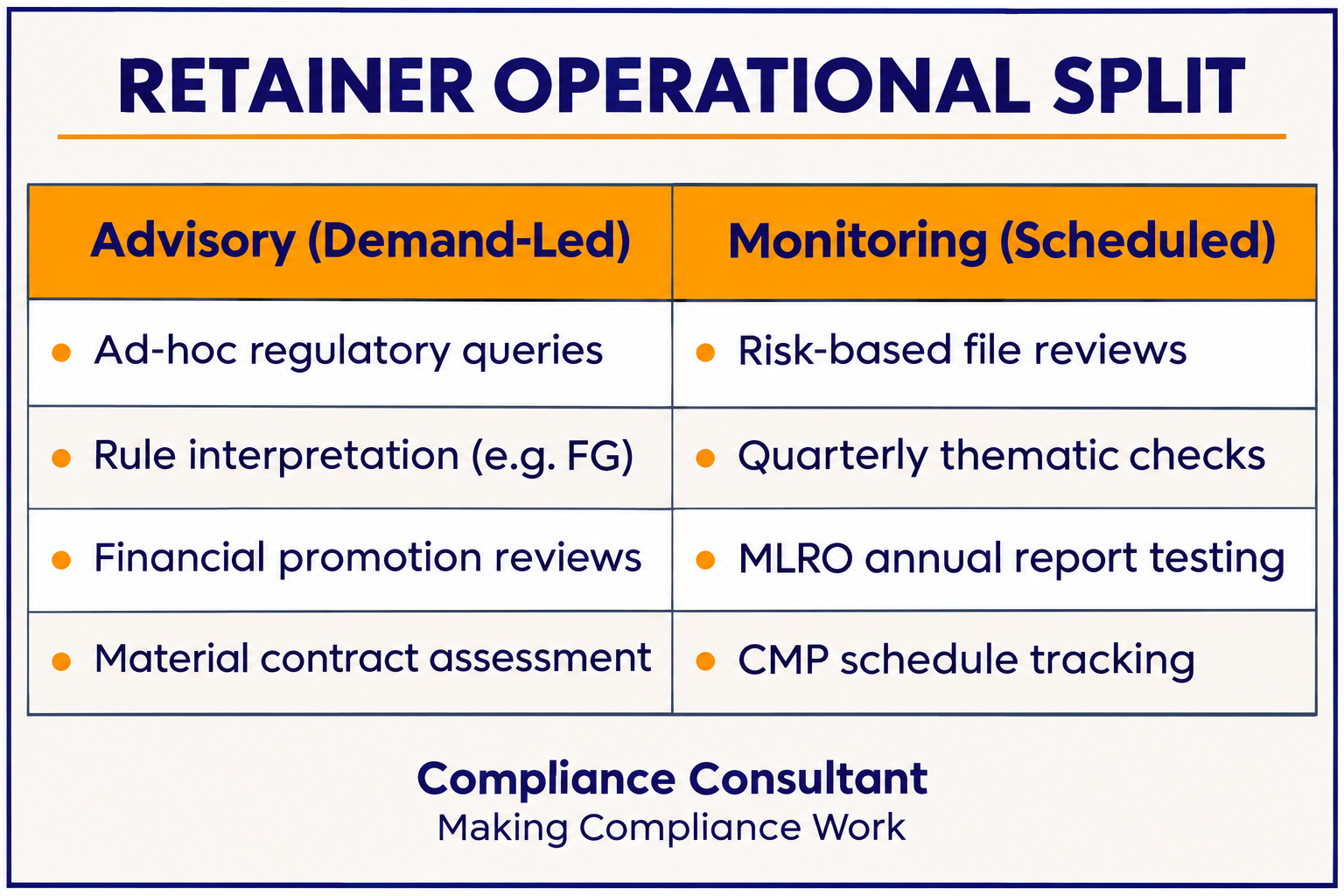
Advisory support and scheduled monitoring
Advisory support is demand-led. It answers questions that arise from running the business: whether a change to a distribution agreement creates an appointed representative relationship, how the financial promotion rules affect a planned campaign, or whether a client categorisation needs re-papering. You get direct access to qualified practitioners who test the proposal against the FCA Handbook, the relevant legislation and assimilated law (the retained EU law now known by that name under the Retained EU Law (Revocation and Reform) Act 2023).
Scheduled monitoring runs to a calendar, regardless of whether anyone has asked a question. It delivers the firm's compliance monitoring programme (CMP): quarterly file sampling, suitability reviews, transaction monitoring reviews and formal oversight of the complaints log.
Retainers can also carry dedicated workflows such as our AML and MLRO support. For firms subject to SYSC 6.3, the FCA's guidance at SYSC 6.3.7G expects the governing body and senior management to receive a report from the Money Laundering Reporting Officer (MLRO), at least annually, on the operation and effectiveness of the firm's anti-money laundering systems and controls. A retained adviser supplies the independent testing behind that report, checking customer due diligence, source of wealth records and suspicious activity reporting against Joint Money Laundering Steering Group (JMLSG) guidance.
Templates and frameworks that actually get used
A working compliance function needs registers, trackers, policies and management information (MI) dashboards. Off-the-shelf templates often sit unused because nobody has time to calibrate them to the firm's permissions.
Inside a retainer, templates are the starting point for our Engage, Execute, Embed methodology. We engage by establishing the regulatory requirements before operational workflows are finalised. We execute by driving process and governance changes alongside day-to-day business. We embed by testing those routines until staff run them consistently.
Matching the retainer tier to your firm
A single-strategy investment boutique with ten institutional clients needs a different compliance tempo from a consumer credit lender with tens of thousands of retail accounts under the Consumer Duty. Choosing a tier means balancing advisory hours against the depth of independent monitoring you need to evidence.
Bronze: the compliance foundation
Bronze suits firms that need core infrastructure, horizon scanning and a technical backstop, but have the internal bandwidth to run daily compliance routines themselves. It fits newly authorised firms in particular. An [FCA authorisation](URL TO CONFIRM) application commits the firm to specific governance standards and controls; once Part 4A permission is granted, those plans have to become working routines. Bronze provides:
- Four hours of technical compliance advisory support a month.
- Email and telephone support, with replies within two business days.
- A monthly regulatory update covering forthcoming rule changes and thematic reviews.
- Access to our regulatory helpline.
- An annual compliance health check questionnaire to identify gaps before they attract supervisory attention.
- Lite versions of core documents: the Compliance Risk Register (six risk categories), Regulatory Horizon Scanning Tracker, Complaints Handling Checklist and Annual Compliance Calendar.
It gives you an external sounding board that stops small omissions, such as a missed regulatory return on RegData, from turning into a supervisory issue.
Silver: senior capacity for an in-house compliance officer
As firms grow in headcount, assets or distribution complexity, SMCR record-keeping, vulnerable customer monitoring and financial crime obligations all become heavier. Silver doubles the advisory allocation to eight hours a month, cuts the response time to one business day, and adds video advisory meetings and a documented quarterly compliance review. Silver clients receive full versions of core toolkits, including the SMCR Responsibilities Mapping Playbook, Complaints Root Cause Analysis (RCA) reporting tools and the Consumer Duty / Operational Resilience Toolkit. It suits firms with a designated in-house compliance officer who needs senior external capacity to keep the annual monitoring plan on track.
Gold: an embedded compliance partner
Gold provides sixteen advisory hours a month, an urgent response within four working hours, a monthly 60-minute strategic board advisory session and a drafted quarterly compliance MI report. Gold clients also get direct mobile access to a named lead consultant, help preparing for FCA supervisory visits, and our advanced frameworks, including the Section 166 Preparation Toolkit, Conduct Rules Breach Investigation Toolkit and Fair Value Assessment Framework.
Firms that are scaling quickly or reorganising their governance often move from unmanaged day rates to a fixed structure. Our case study on moving to a fixed compliance retainer shows how that transition works.
What it costs, against an in-house hire and ad hoc day rates
| Tier | Monthly (quarterly billing) | Monthly (annual billing) | Annual cost, annual billing | Advisory hours | Response time |
|---|---|---|---|---|---|
| Bronze | £595 + VAT | £535 + VAT | £6,420 + VAT | 4 hours a month | 2 business days |
| Silver | £1,195 + VAT | £1,075 + VAT | £12,900 + VAT | 8 hours a month | 1 business day |
| Gold | £2,395 + VAT | £2,155 + VAT | £25,860 + VAT | 16 hours a month | 4 working hours |
All fees are quoted net of VAT. Under our published terms, time outside the agreed allocation is never billed without your prior agreement. Annual billing saves about 10%: £720 a year on Bronze, £1,440 on Silver and £2,880 on Gold.
The in-house comparison, shown in full
The figures below are an illustrative worked example, not market data. Replace them with your own salary benchmark.
| Year-one cost of an in-house compliance manager | Amount |
|---|---|
| Base salary (assumed) | £60,000 |
| Employer National Insurance (15% above the £5,000 secondary threshold) | £8,250 |
| Employer pension contribution (assumed 5% of salary) | £3,000 |
| Recruitment fee (assumed 20% of salary, year one only) | £12,000 |
| Total, year one | £83,250 |
On those assumptions, Gold on annual billing costs 31% of a year-one in-house hire, Silver 15.5% and Bronze 7.7%. From year two the recruitment fee falls away and the in-house figure drops to £71,250; Gold is then 36% of the in-house cost, Silver 18% and Bronze 9%. The example also leaves out training, cover for leave and absence, and the cost of the role sitting vacant while you recruit.
Gold delivers sixteen hours of senior consultant support a month, a drafted quarterly board report and a specialist toolkit suite with a standalone retail value of £2,155 a month plus VAT on annual billing. See https://bit.ly/CCRetMenu for details.
The ad hoc alternative
Relying on day-rate consultants creates the opposite problem: unpredictable cost. In the firms we have reviewed, teams paying by the hour hesitate to ask early questions because a short call might generate an unexpected invoice. Issues get parked until they become urgent and expensive to fix. A retainer removes that hesitation by fixing the price and the scope in advance.
A retainer is not the right answer for every firm. If you need a full-time, on-site compliance leader who sits in every product and board discussion, or your volumes and retail exposure justify a dedicated team, an in-house hire supported by project-based consultancy may suit you better. A retainer is strongest where you need senior expertise and continuity without a full-time salary.
How your board should test the arrangement every year
SYSC 8.1.8R sets conditions for outsourcing, including that the firm keeps the expertise to supervise the outsourced functions and manage the risks of the arrangement. In practice, that means your board should formally test the retained relationship at least once a year. Leaving a retainer running in the background without review is a common governance failing.
As part of our Compliance Governance Reviews, we recommend boards test their external arrangements against five benchmarks:
- Fit with the current business model. Does the written service schedule match the firm's current permissions and operations, or the firm as it was twelve months ago?
- Delivery against the compliance monitoring plan. Did the provider complete every file check, risk assessment and thematic review in the annual CMP on time?
- Quality of MI. Does the provider's reporting give clear metrics on complaint root causes, financial crime risk and Consumer Duty outcomes, so the board can make decisions?
- Independent challenge. Has the adviser challenged the business on its shortcomings, or acted as a rubber stamp for executive proposals?
- Knowledge transfer. Is the arrangement raising the regulatory competence of your own staff, or creating an unmonitored dependency?
Boards that minute their answers to these questions build a defensible governance record. If the FCA uses its power to require information under section 165 of the Financial Services and Markets Act 2000, or appoints a skilled person under section 166, the firm can show both competent execution and active senior management oversight.
For more on choosing a provider, see our guide to [evaluating FCA compliance consultants](URL TO CONFIRM) and our comparison of in-house, outsourced and hybrid compliance models for mid-sized UK investment firms.
Frequently asked questions
Can an FCA-regulated firm outsource its compliance function?
It can outsource compliance tasks, but not responsibility for them. SYSC 8.1.6R says a firm that outsources critical or important operational functions remains fully responsible for discharging all its obligations under the regulatory system. The firm must still allocate oversight to a senior manager, supervise the provider and keep evidence of that supervision.
Who should oversee an outsourced compliance arrangement?
For core and enhanced SMCR firms, usually the Chief Executive (SMF1) or the Compliance Oversight function holder (SMF16). Limited scope firms and firms outside SMCR, such as payment and e-money institutions, still need a named senior individual who reviews and challenges the provider's work.
How much does a compliance retainer cost?
Compliance Consultant's retainers cost £595, £1,195 or £2,395 a month plus VAT for Bronze, Silver and Gold on quarterly billing, or £535, £1,075 and £2,155 a month plus VAT on annual billing. Annual costs on annual billing are £6,420, £12,900 and £25,860 plus VAT.
Does the MLRO have to report to the board every year?
For firms subject to SYSC 6.3, the FCA's guidance at SYSC 6.3.7G expects the governing body and senior management to receive an MLRO report at least annually on the operation and effectiveness of the firm's anti-money laundering systems and controls. It is guidance rather than a rule, but the FCA's Financial Crime Guide treats a board that never considers MLRO reports as poor practice.
How often should the board review its compliance retainer?
At least once a year, against the current business model, delivery of the compliance monitoring plan, the quality of MI, the adviser's independent challenge and the transfer of knowledge to internal staff.
Next step
To see how a retainer would fit your firm's permissions, or to arrange a review of your current compliance arrangements, book a free discovery call at https://bit.ly/CCDiscovr, call UK Freephone 0800 689 0190 or our international line 020 8243 8620, or email info@complianceconsultant.org. Full scope details and sign-up are on our [Compliance Retainer Services page](URL TO CONFIRM). Making Compliance Work.
This article is general information, not legal advice. Compliance Consultant and Compliance Doctor are trading styles of UK Compliance Consultant Limited, Companies House number 14805896. UK Compliance Consultant Limited is not authorised by the FCA.