The state of UK regulatory compliance outsourcing in 2026: how to evaluate partners

A full-time compliance manager now costs over £100,000 annually when factoring in base salary, employer National Insurance, and pension contributions, yet hiring a cut-price external consultancy to save overhead can trigger an FCA Section 166 review that costs three times as much as the initial saving. Drawing on founder Lee Werrell's 25+ years of experience guiding UK regulated firms through authorisation and ongoing supervision, Compliance Consultant advises Heads of Compliance and fintech founders to evaluate UK regulatory compliance outsourcing companies against three strict criteria in 2026. You must test every prospective provider against FCA Handbook SYSC 13.9 outsourcing rules, verify that the individual consultants assigned to your account hold QCF Level 6+ qualifications alongside senior management backgrounds, and confirm how the partner protects your personal liability under the Senior Managers and Certification Regime (SMCR). Firms looking for structured, fixed-price external support should benchmark any proposal against Compliance Retainer Services for FCA-regulated Firms before committing to a contract.
The £100,000 hiring threshold and Section 166 risk in UK compliance outsourcing
Hiring an in-house compliance manager in London or Manchester carries a fixed cost above £100,000 a year once employer National Insurance and pension contributions sit on top of base pay. For a mid-sized investment firm or a scaling payments business, that single salary strains operational budgets. Yet the cheapest alternative often creates the largest bill. As documented in How to Evaluate and Choose an FCA Compliance Consultant in 2026, a failed external engagement that leads to an FCA Section 166 skilled person review frequently costs three times the initial saving.
When a regulatory intervention hits, the board pays twice: first for the original provider's fees, and again for remediation, legal counsel, and skilled person reporting. Understanding those downside costs is why many compliance leaders review The complete guide to managing an FCA Section 166 review alongside procurement budgets. The market in 2026 splits into three distinct models, each carrying a different risk profile for SMCR function holders.
| Outsourcing model | Oversight depth | SMCR liability protection | Regulatory audit readiness |
|---|---|---|---|
| SaaS compliance platforms | Automated workflow tracking and generic alerts | Minimal; software cannot defend judgement calls to a supervisor | Low without internal senior interpretation |
| Low-cost template providers | Standardised documents with firm names inserted | Weak; generic manuals fail supervisory scrutiny | Poor; policies rarely match actual permissions |
| Senior-led retained consultancies | Direct advisory hours, scheduled reviews, and tailored MI | High; senior specialists challenge board blind spots | Audit-ready frameworks mapped to firm permissions |
Software platforms help teams track deadlines, as noted in How to Choose a Compliance Services Company in 2026, but software does not interpret grey areas in the FCA Handbook. Low-cost template vendors create an even sharper trap because they give boards false comfort until a supervisory visit exposes gaps between written procedures and daily practice.
Senior-led retained models bridge that gap without the £100,000+ fixed payroll commitment. At Compliance Consultant, Bronze, Silver, and Gold retainers start from £595 a month plus VAT, with the Gold tier priced at £2,395 plus VAT. Each tier sets a fixed monthly fee agreed before work begins, giving firms senior advisory hours, scheduled reviews, and a library of compliance templates. For a fuller breakdown of how monthly retainers map to deliverables, read The FCA compliance retainer: actual costs and what gets delivered and check exact tier inclusions on Compliance Retainer Services for FCA-regulated Firms.
Why FCA SYSC 13.9 and SUP 15.3.8 govern every vendor choice
Contracting out compliance tasks changes your operational risk profile without shifting a single ounce of regulatory responsibility. Under SYSC 3.2.4 G in the FCA Handbook - SYSC 13.9 Outsourcing, a firm cannot contract out its regulatory obligations and must take reasonable care to supervise outsourced functions. Principle for Business 3 reinforces that duty, and as What are the FCA Rules on Outsourcing Services? sets out, the FCA's 2022 guidelines require firms to document their monitoring practices rather than relying on informal check-ins.
Before signing or materially altering an outsourcing agreement, SYSC 13.9 requires firms to complete five pre-contract checks:
- Analyse how the arrangement fits your organisation, reporting structure, business strategy, risk profile, and ability to meet regulatory obligations.
- Confirm that the written contract gives you sufficient rights to monitor and control operational risk exposure.
- Conduct due diligence on the service provider's financial stability and technical expertise.
- Plan a smooth transition from existing arrangements and define what happens when the contract terminates.
- Assess concentration risk, including business continuity exposure if one provider serves many firms in your sector.
SYSC 13.9 also warns firms not to assume that an outsourcing arrangement carries lower operational risk simply because the supplier is itself regulated or sits within the same corporate group. In June 2026, legal analysts at Pinsent Masons noted in Agentic AI changes supplier due diligence for financial services firms that when suppliers use autonomous AI tools to categorise risks or trigger checks, regulated firms must audit how the supplier verifies outputs, controls data, and maintains human oversight.
Assessing material outsourcing and SUP 15.3.8 G notifications
Not every external advisory contract counts as material outsourcing, but handing over ongoing compliance monitoring, MLRO support, or core financial crime screening often crosses that threshold. Under SUP 15.3.8 G (1)(e), a firm must notify the FCA when it intends to enter into a material outsourcing arrangement. Failing to assess materiality before onboarding a vendor leaves an immediate gap on your regulatory record.
For dual-regulated firms and payment system operators, the bar rises further over the next year. The Bank of England and Prudential Regulation Authority published updated supervisory expectations in March 2026 via SS2/21 – Outsourcing and third party risk management, taking effect on 18 March 2027, which codifies pre-outsourcing materiality assessments, audit access rights, and sub-outsourcing controls. Even solo-regulated FCA fintechs benefit from mirroring those written agreement standards during vendor procurement.
Building exit strategies and avoiding concentration risk
A compliance outsourcing contract should never lock your firm into a single provider's proprietary workflow. If a retainer relationship stops working, you need a documented backup plan and clean data portability so you can switch partners without interrupting monitoring cycles. Ask prospective consultancies how policies, risk registers, and monitoring logs are handed over at termination. If the provider houses your compliance records inside a closed portal that exports only static PDFs, your exit cost will be high.
Evaluating consultant seniority and QCF Level 6+ standards
Many UK compliance buyers discover too late that the senior partner who pitched the account hands daily work to a junior analyst armed with boilerplate templates. The FCA regularly penalises firms whose manuals describe business lines they do not operate or omit controls for permissions they actually hold. That gap is the clearest dividing line between a genuine advisory consultancy and a rebranded template vendor.
When interviewing prospective partners, look past firm-wide client counts and inspect the qualifications of the specific person reviewing your files. Compliance Consultant operates with a team of seven qualified consultants where none hold qualifications below QCF Level 6+ and every consultant brings at least five years of senior management experience, as detailed in Are You Using These 9 Top Ways To Comply With The FCA Regulations? and Compliance Doctor Among Ten Thought Leaders Driving Change. Senior practitioners recognise operational bottlenecks immediately because they have managed regulated teams themselves.

Consultant seniority matters even more for pre-authorisation fintechs and start-ups. While official FCA service targets for complete applications sit around four months, real-world processing ranges closer to six months or longer, and How to Get FCA Authorisation in 2026: A Step-by-Step Guide notes that an incomplete or poorly drafted application can add six months or more to the timeline. Firms preparing submissions for FCA Authorisations should test whether an adviser applies a disciplined engage, execute, embed methodology: engage to establish regulatory requirements before infrastructure is built, execute to drive process and organisational change in parallel with technology development, and embed to integrate compliance into real-world operations through testing and scaling. Reading The regulatory business plan: what the FCA actually looks for will help you spot whether a candidate consultant knows how case officers test capital, wind-down, and operational projections.
High-scrutiny outsourcing for AML, MLRO support, and governance
Some compliance functions tolerate minimal external input, while others carry immediate enforcement exposure if outsourced poorly. Under the FCA's 2025–2030 strategy, financial crime controls and board-level governance remain top supervisory priorities. Outsourcing either area requires deeper technical vetting than general policy drafting.
Scrutinising AML and KYC outsourcing under UK money laundering regulations
Scaling payment institutions and investment firms frequently outsource Customer Due Diligence (CDD), Know Your Customer (KYC) verification, and transaction monitoring to manage rising volumes. As AML & KYC outsourcing in the UK: Regulations & Compliance explains, these arrangements sit squarely under the Money Laundering, Terrorist Financing and Transfer of Funds (Information on the Payer) Regulations. Transferring document checks or sanctions screening to an external team never transfers statutory liability away from your Money Laundering Reporting Officer (MLRO).
Any external AML partner must show how they calibrate alert thresholds to your specific customer risk assessment rather than running default settings. When engaging external specialists for annual MLRO board reports, financial crime audits, or framework reviews, review the scope outlined in AML & MLRO Support for UK authorised businesses. Ask how the consultancy tests transaction monitoring logic against real suspicious activity typologies in your sector.
Testing SMCR, Consumer Duty, and governance review capabilities
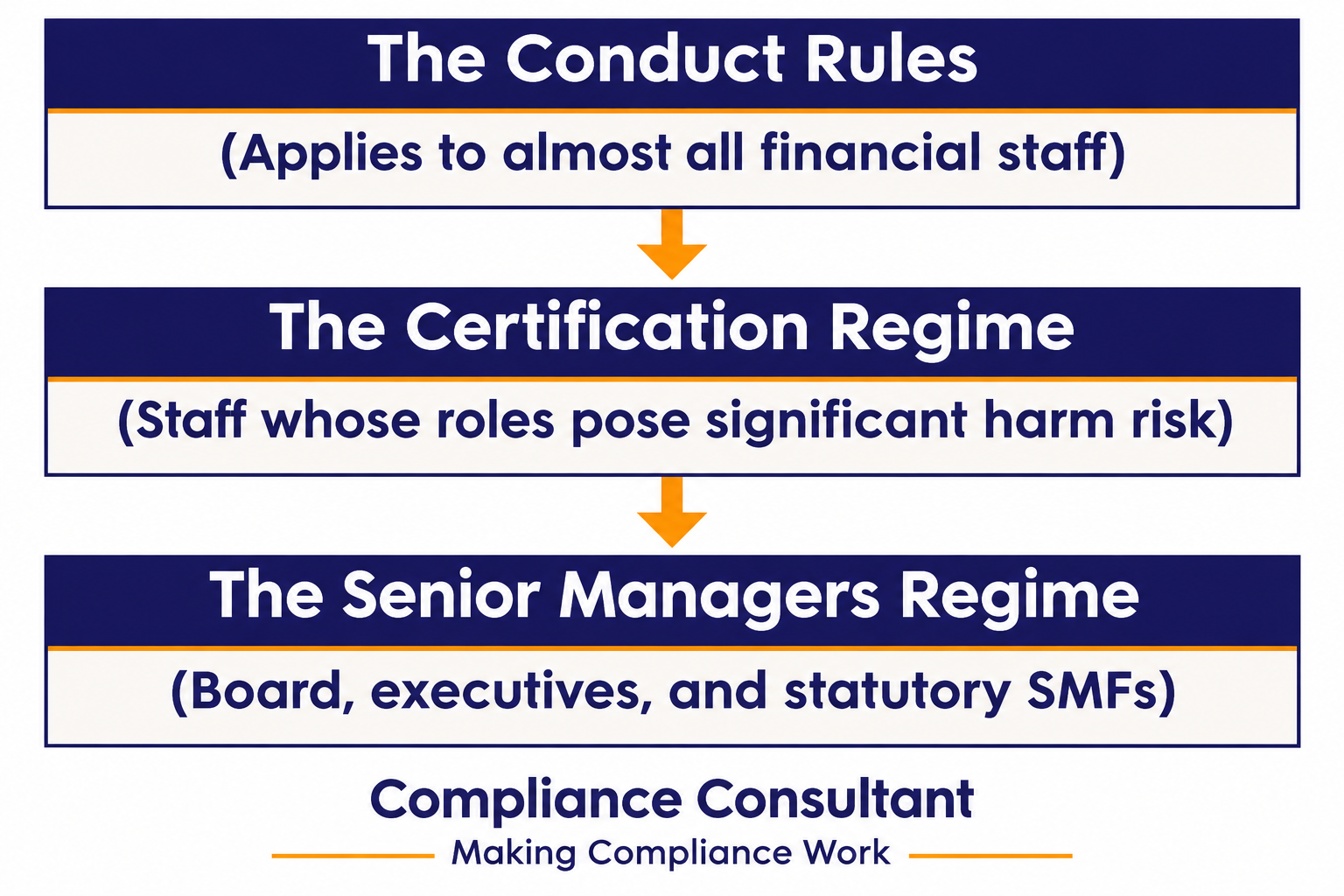
Outsourced support must also withstand scrutiny at board level. Under SMCR, Senior Managers hold direct accountability for reasonable steps taken within their prescribed responsibilities. A compliance partner that simply sends monthly regulatory newsletters does nothing to evidence that your board challenges risk data or oversees Consumer Duty outcomes effectively.
When commissioning an independent, evidence-based review of how your firm is really governed—covering SMCR arrangements, board and committee effectiveness, risk and compliance frameworks, management information, and Consumer Duty oversight—look for structured, RAG-rated board reporting rather than vague commentary, as set out in Compliance Governance Reviews - FCA Secrets Revealed. Compliance Consultant also introduced the first commercially available FCA Consumer Duty Template Policy in general UK release, giving smaller firms a structured baseline to adapt rather than starting from a blank page.
Shifts in FCA supervision and what UK compliance leaders should expect through 2027
The FCA's 2025–2030 strategy and recent thematic reviews show a regulator focused on measurable customer outcomes and operational accountability. In its March 2025 Vulnerable Customer Review, cited in How to Evaluate and Choose an FCA Compliance Consultant in 2026, the FCA found that only 54% of firms with vulnerability training for non-frontline staff provided guidance explaining how vulnerability related to those specific roles. Firms relying on fragmented, ad-hoc advice missed that detail months before the review landed.

Leading vs lagging indicators in FCA supervisory interventions
Heads of Compliance should track leading indicators of regulatory trouble inside their own outsourcing relationships rather than waiting for formal FCA action.
- Leading indicators include boards receiving volume-based activity counts instead of outcome-based Management Information, risk registers that remain unchanged across quarters, and compliance policies that lag behind product launches.
- Lagging indicators include Dear CEO letters targeting your sector, formal information requests under statutory powers, and Section 166 skilled person appointments.
If your external consultant only flags issues after a Dear CEO letter arrives, you are paying for reactive administration rather than preventative oversight.
Two testable predictions for UK compliance outsourcing in 2027
First, FCA supervisory teams will increasingly challenge firms that rely on uncalibrated SaaS compliance tools or AI screening without documented human-in-the-loop governance. As automation spreads across financial crime and monitoring workflows, supervisors will ask Senior Managers to prove how automated outputs are sampled, challenged, and overridden. Firms updating their internal controls for automated tools can review AI Regulation Compliance Simplified: A Comprehensive Guide for FCA-Regulated Firms to prepare audit trails ahead of supervisory visits.
Second, personal accountability inquiries under SMCR will focus heavily on how Senior Managers actively audited their outsourced compliance and AML providers rather than merely filing annual attestations. Signing a vendor contract and holding an annual review call will not satisfy the reasonable steps test. Firms reassessing their senior manager oversight duties can cross-check expectations in Core vs Enhanced SMCR categorisation: what the FCA expects from your firm.
The 6-step vendor due diligence audit before signing a compliance retainer
Before committing budget to any UK regulatory compliance outsourcing company, put prospective partners through a structured procurement test. Each step below produces documentary evidence you can file directly against your SYSC 13.9 obligations.
- Request the exact CV and QCF qualification level of the named consultant assigned to your account, not the senior partner leading the sales call.
- Ask to inspect redacted examples of board-level Management Information and RAG-rated governance action plans produced for similar FCA-regulated firms.
- Verify contract SLAs, fixed-fee scoping, and response times in writing against benchmarks such as Compliance Retainer Services for FCA-regulated Firms.
- Test how the consultancy maps its templates to your exact FCA permissions by asking them to identify two gaps in your current framework during scoping.
- Audit the provider's own use of AI tools, data security controls, and any sub-outsourced administrative teams to avoid hidden third-party concentration risk.
- Review independent client feedback, such as Compliance Consultant's 4.6 stars from 107 reviews, alongside direct reference calls with firms of comparable size and regulatory category.
To benchmark your current outsourcing arrangements or scope fixed-price compliance support for 2027, book a discovery call with Compliance Consultant on 0800 689 0190, email info@complianceconsultant.org, or review the retainer tiers at Compliance Retainer Services for FCA-regulated Firms.
UK Compliance Consultant Limited is not authorised by the FCA and does not give regulated advice to consumers; our role is to help your firm meet its own regulatory obligations.