The ROI of FCA Consumer Duty compliance: what the data shows

For mid-sized FCA-regulated firms, calculating the return on investment (ROI) of Consumer Duty compliance requires looking past initial policy drafting costs to measure balance-sheet protection, faster product sign-off, and complaint reduction under FCA Handbook PRIN 2A (PRIN 2A The Consumer Duty). At Compliance Consultant, our review of post-implementation frameworks shows that firms pairing automated compliance monitoring with rigorous PRIN 2A.4 fair value assessments (PRIN 2A.4 Consumer Duty: price and value) turn regulatory obligations into commercial defences against Financial Ombudsman Service (FOS) interventions and Section 166 skilled person reviews. This analysis breaks down where conventional compliance budgeting miscalculates the cost of the Duty, and how Heads of Compliance and Risk in London and across the UK can quantify the financial return of their governance frameworks across product lifecycles, financial promotions, and external advisory retainers.
Why treating Consumer Duty as a sunk cost breaks your risk model
Many mid-sized investment boards still view the Consumer Duty as a static project completed between July 2023 and July 2024. That accounting mindset treats compliance spend as a sunk administrative overhead rather than an active financial control. When a firm generating £50 million in annual revenue budgets for Consumer Duty purely as a documentation exercise, its risk model misses the largest variable on the balance sheet: retrospective remediation.
Consider the scale of sector-wide liability when conduct controls fail. Following the FCA ban on discretionary commission arrangements (DCAs) and the January 2024 FOS decisions upholding customer complaints, analysts projected up to £16 billion in motor finance redress liabilities (Motor Claims Management Company UK - Key Insights). A surge in complaints or an industry-wide redress scheme under the Financial Services and Markets Act can threaten the solvency of specialised firms.
Under PRIN 2A, the Duty replaced Principles 6 and 7 for retail market business, establishing a binding standard interpreted against what a prudent firm carrying on the same activity would do under PRIN 2A.7.1R (PRIN 2A The Consumer Duty). While the FCA confirms that the Duty does not apply retrospectively, its definition of a closed product is strict (Consumer Duty information for firms). Any existing product marketed, distributed, or renewed on or after 31 July 2023 falls squarely under PRIN 2A.4.2R and PRIN 2A.4.3R (PRIN 2A.4 Consumer Duty: price and value).
For a London investment firm, legacy fee structures and ongoing distribution chains carry live regulatory exposure. In our work as a UK regulatory compliance consultancy, we find that boards only discover these gaps during an external inspection. Commissioning an independent, evidence-based Compliance Governance Review tests how your firm is really governed across SMCR arrangements, board and committee effectiveness, risk and compliance frameworks, management information, and Consumer Duty oversight, giving your board a RAG-rated action plan before a supervisor intervenes.
Price and value assessments under PRIN 2A.4 as margin and retention protection
Under PRIN 2A.4, fair value is defined as a reasonable relationship between the amount paid by a retail customer and the benefits they can reasonably expect from the product (PRIN 2A.4 Consumer Duty: price and value). Firms that treat fair value assessments as a narrow peer-pricing spreadsheet miss half the rulebook and most of the commercial upside.
| Consumer Duty outcome | FCA Handbook rule | Traditional cost view | Commercial and risk ROI metric |
|---|---|---|---|
| Products and services | PRIN 2A.3 | Annual target market paperwork | Lower mis-selling redress and fewer product withdrawals |
| Price and value | PRIN 2A.4.2R / 2A.4.3R | Fee benchmarking against peers | Reduced churn, defensible margins, lower complaint volumes |
| Consumer understanding | PRIN 2A.5.10R / COBS 4 | Legal sign-off bottleneck | Higher onboarding conversion and fewer pulled campaigns |
| Consumer support | PRIN 2A.6 | Call centre and DISP admin overhead | Faster resolution, reduced FOS referrals, lower attrition |
Quantifying non-financial friction costs in the product lifecycle
Value under PRIN 2A.4 extends well beyond headline annual management charges. As detailed in our FCA Consumer Duty summary and template policy, firms must evaluate non-financial costs, including the time and effort customers spend trying to buy, amend, switch, or cancel a product, alongside qualitative service metrics.
Friction in servicing or exit journeys ("sludge" practices) directly inflates operational costs. Every unclear redemption process or delayed transfer triggers avoidable inbound queries, formal DISP complaints, and FOS referrals. Removing that friction reduces complaint-handling overhead and protects client retention. When Compliance Consultant built the UK's first commercially available, 20+ page editable Consumer Duty template policy for FSMA, Payment Services, and Consumer Credit firms, we structured the value framework specifically around these operational touchpoints.
Defensive documentation before product adaptation or renewal
PRIN 2A.4.3R requires manufacturers to complete an initial value assessment before a product or any significant adaptation is marketed or distributed, and to remain satisfied that fair value holds through any renewal period (PRIN 2A.4 Consumer Duty: price and value).
Documenting that rationale upfront prevents expensive mid-cycle fee rebates or forced product withdrawals. It also gives your compliance team clear evidence when reviewing suitability files against FCA expectations, turning subjective pricing debates into auditable board records.

Reducing customer acquisition friction and promotion rework under PRIN 2A.5 and COBS 4
Marketing and compliance teams in UK investment firms often clash over financial promotions. Compliance officers worry about regulatory breach, while commercial directors worry that dense legal caveats will tank conversion rates. Getting consumer understanding right on the first draft resolves both problems and saves substantial marketing budget.
What the April 2026 risk warnings review means for mainstream investments
On 9 April 2026, the Investment Association published its risk warnings review, supported by the FCA and the Treasury, prompting updated FCA expectations in May 2026 for mainstream investment products outside COBS 22 restrictions (Risk warnings for mainstream investments). The FCA reiterated that financial promotions likely to reach retail customers must satisfy both COBS 4.2.1R(1) (fair, clear and not misleading) and COBS 4.5.2R(2) or COBS 4.5A.3R(2)(b) (a balanced impression of benefits and risks).
Misunderstanding how to balance risk and reward carries a direct financial cost. Overly technical boilerplate drives suitable retail investors out of the onboarding funnel, while understated warnings invite FCA supervisory action and forced campaign withdrawals.
Testing financial promotions under PRIN 2A.5.10R to protect conversion rates
Under PRIN 2A.5.10R, firms must test communications where appropriate to verify that target customers actually understand them (Risk warnings for mainstream investments). Treating testing as a pre-launch commercial discipline rather than a post-complaint fix protects customer acquisition spend.
At Compliance Consultant, we advise regulated firms to test layout, risk prominence, and plain-English disclosures before media spend is committed. When a firm validates comprehension early, it avoids the cost of pulling live assets, re-briefing creative agencies, and remediating clients who misunderstood product risks at the point of sale.
Accelerating regulatory approvals and cutting manual oversight costs
Consumer Duty maturity also drives return on investment through operational speed. Two areas show immediate, measurable gains for growing UK investment firms and fintechs: regulatory permission timelines and senior compliance headcount allocation.
Business model Threshold Conditions for new permissions in 2026
Our 2026 guidance on how to get FCA authorisation reflects a material shift in regulatory scrutiny: the FCA now examines a firm's Consumer Duty implementation plan as part of its business model Threshold Condition assessment before granting permissions. Whether a firm is applying for initial FCA authorisations or a variation of permission to launch a new retail product line, incomplete Duty documentation stalls the application.
While the FCA operates against statutory processing targets, real-world authorisation and variation timelines frequently stretch further when case officers raise repeated queries over governance and customer outcomes. Embedding a version-controlled Consumer Duty framework during the business design phase prevents months of commercial delay and lost revenue.
Reclaiming senior headcount through automated monitoring systems
Manual spreadsheet tracking drains the capacity of experienced compliance managers. Across the UK advisory market, firms are already feeling the squeeze: in a 2023 Quilter and Boring Money survey, 44% of financial advisers expected profitability to drop due to Consumer Duty costs averaging £18,161 (Advisers fear profit dip from £20,000 Consumer Duty compliance costs). By 2025, Model Office's Cost of Compliance Survey across more than 800 firms highlighted sustained margin compression alongside rising professional indemnity premiums and wider FCA data requests (Model Office Cost of Compliance Survey 2025).
Shifting from ad-hoc manual checks to automated compliance monitoring systems reverses that resource drain (SRA COFA & COLP: Understanding Compliance Consultant Benefits). Automated systems flag data discrepancies in real time, allowing a £50 million investment firm to redirect senior compliance staff from routine file sampling toward strategic product governance and board advisory work.
Resourcing the framework: fixed-price external retainers versus internal headcount
A 100-person investment firm rarely needs another permanent six-figure compliance hire to maintain Consumer Duty standards, yet relying solely on generalist internal staff leaves dangerous blind spots. Deciding between internal recruitment and retained external support comes down to predictable cost and specialist depth.
Outsourcing parts of the compliance function gives firms access to professionals dedicated to tracking and interpreting regulatory changes, though boards must actively manage potential risks around process control and data security. Measuring the return on external support depends on tracking clear KPIs: the frequency of compliance issues, response times to regulatory updates, and overall cost efficiency.
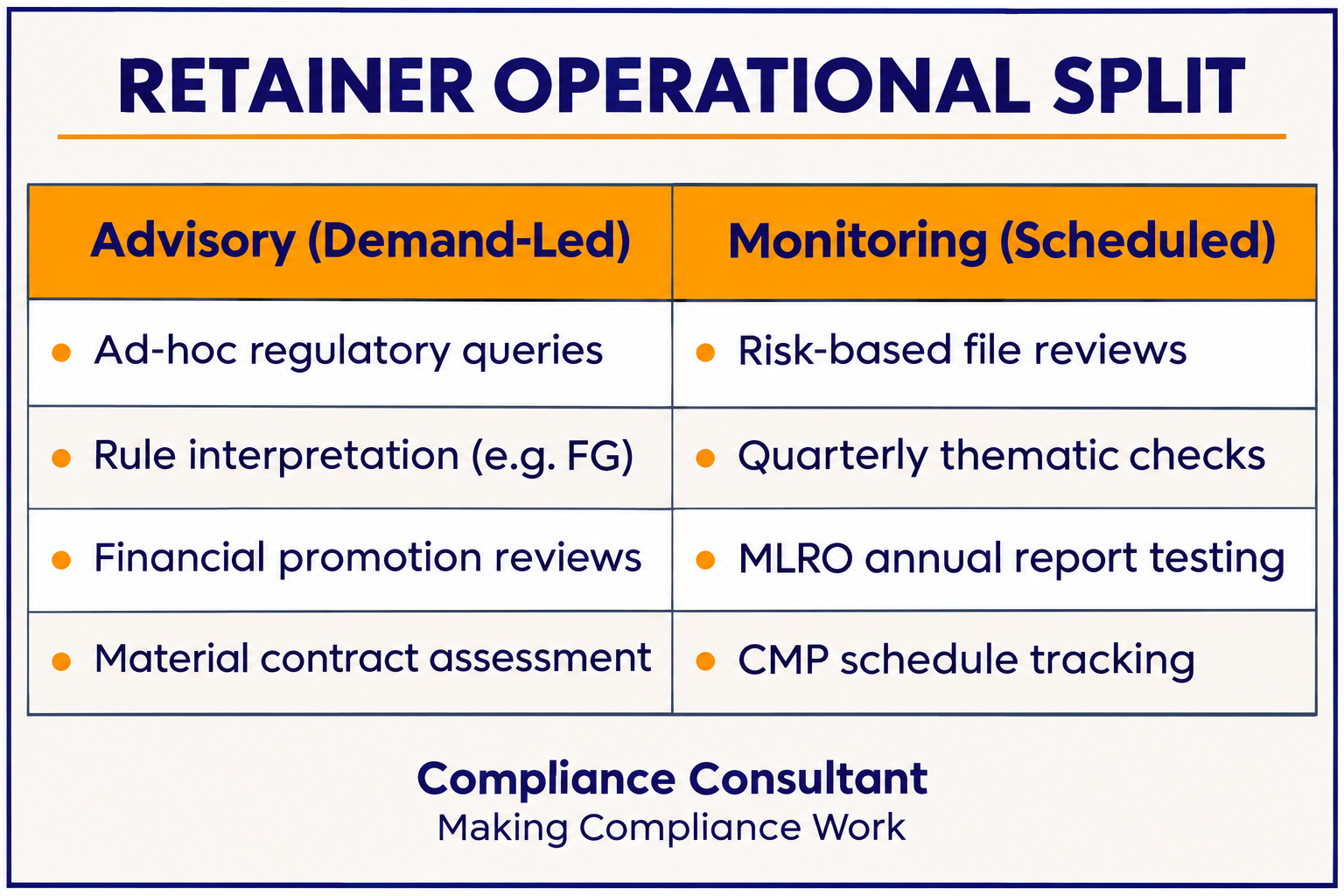
At Compliance Consultant, we structure ongoing support through tiered Compliance Retainer Services for FCA-regulated Firms across Bronze, Silver, and Gold levels, with our Gold tier priced at £2,395 + VAT. Firms evaluating what gets delivered under an FCA compliance retainer can review exact tier inclusions and response commitments directly on our retainer page rather than guessing at variable hourly consultancy bills.
Crucially, retained support works best when it connects Consumer Duty oversight to the rest of your annual governance calendar, including AML reviews and MLRO support and risk-based annual compliance monitoring plans. A retainer gives you structured advice and independent challenge; formal responsibility for regulatory compliance remains with your firm and its senior managers.
Building the boardroom business case for your next governance review
For a Head of Compliance and Risk presenting to an executive committee, the fastest way to secure budget is to reframe Consumer Duty MI around risk-adjusted capital preservation. The FCA monitors firms closely and applies the Senior Managers and Certification Regime (SM&CR) proportionally to firm size, holding senior individuals directly accountable for conduct standards (About the FCA).
Before your next board cycle, audit your Consumer Duty MI against five practical checkpoints:
- Track complaint root causes and DISP redress trends alongside FOS referral rates to spot recurring product friction before it scales.
- Pair PRIN 2A.4 fair value reviews with client retention and redemption data so margin defence is visible to commercial directors.
- Log pre-launch testing results under PRIN 2A.5.10R for all retail financial promotions, tying clear disclosures to onboarding conversion rates.
- Monitor automated compliance alerts against your annual monitoring plan to quantify senior staff hours saved.
- Benchmark your board reporting against post-implementation Consumer Duty expectations and prepare for external scrutiny well ahead of any FCA Section 166 review.
When your board sees hard numbers linking PRIN 2A controls to lower complaint remediation, faster permission approvals, and protected client retention, compliance stops looking like an unrecoverable cost centre. Under SM&CR, the annual Consumer Duty board report is no longer a passive sign-off; it is the primary record of whether your senior managers protected the firm's balance sheet and its retail clients.
To pressure-test your Consumer Duty oversight, SMCR accountability, and board management information, book an independent Compliance Governance Review or explore our fixed-price Compliance Retainer Services at https://complianceconsultant.org/. Compliance Consultant is rated 4.6 stars from 107 reviews and has been led by founder Lee Werrell, who brings over 25 years of industry experience. Call us on 0800 689 0190 or email info@complianceconsultant.org to speak with our team.
Regulatory status notice: Compliance Consultant is a trading style of UK Compliance Consultant Limited. UK Compliance Consultant Limited is not authorised by the FCA and does not provide regulated advice to consumers.